







Quick answer: Budget for rent as the rent itself plus the cost of paying it. That covers any per-payment fee for your chosen method, your own bank’s charges, and the risk costs of a failed payment or a card balance you do not clear. Compare flat and percentage fees at your actual rent, line rent day up with your pay schedule, and keep a buffer to reduce the chance of an automatic payment reaching an account with insufficient funds.
Rent is usually the biggest fixed line in a household budget, so it is tempting to treat it as one number. In practice, the amount that leaves your accounts over a year can be higher than twelve times the rent. Payment fees, bank charges and the odd mistake add up quietly, and the cheapest way to pay is not always the option with the smallest headline fee.
This guide breaks the true cost of paying rent into parts you can estimate, with illustrative arithmetic you can redo using your own figures. It is general information, not financial advice.
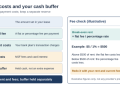
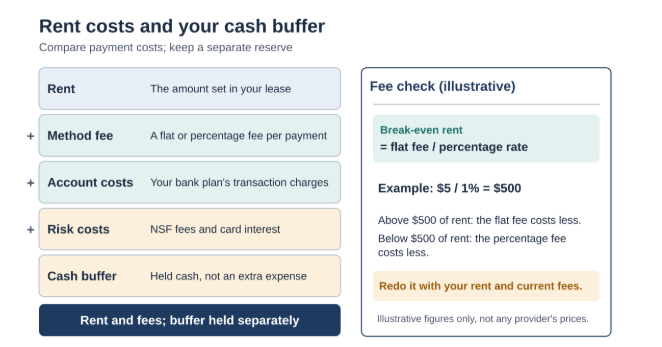
Rent and payment costs, with a separate retained cash buffer and an illustrative fee comparison.
Payment Costs and a Separate Cash Buffer
- The rent. The amount set in your lease.
- The method fee. Some payment methods are free; others carry a flat fee or a percentage of each payment.
- Account costs. Your bank plan may charge for transactions or transfers.
- Risk costs. A returned payment can trigger a non-sufficient funds (NSF) fee, and a card balance you do not pay in full attracts interest.
- A separate cash buffer. Money kept available for timing problems. It is a balance you retain, not an extra fee or an expense to add to annual rent costs.
Flat Fees Versus Percentage Fees
Payment fees usually come in two shapes. A flat fee costs the same whatever your rent. A percentage fee grows with it. To compare them, find the break-even rent by dividing the flat fee by the percentage rate.
Illustrative example. Assume one option costs $5 per payment and another costs 1% of the payment. The break-even rent is $5 ÷ 0.01 = $500. Above $500 a month, the flat fee is cheaper; below it, the percentage fee is. At most rents, a flat fee of a few dollars wins on cost alone, which is why the shape of a fee matters more than the number printed next to it.
The table below applies three illustrative fee levels to an assumed rent of $1,800 a month. These figures are not any provider’s prices.
| Illustrative fee | Monthly cost | Annual cost |
|---|---|---|
| Flat $5 per payment | $5.00 | $60.00 |
| 1% of each payment | $18.00 | $216.00 |
| 2.5% of each payment | $45.00 | $540.00 |
The arithmetic: 12 × $5 = $60. 1% of $1,800 is $18, and 12 × $18 = $216. 2.5% of $1,800 is $45, and 12 × $45 = $540.
A percentage fee is not automatically a poor deal. If a card gives you something you value, such as a reward you are sure to use or a way to smooth cash flow, you can weigh that against the fee. Compare like with like, after fees, and leave out any reward or perk you are not certain to receive.
Where the Method Fee Shows Up
Platforms that accept several payment methods usually price each one differently. TenantPay, for instance, lists a separate fee for each method it accepts and lets renters pick a method for each payment. That flexibility helps your budget only if you check the current fee for the method you actually plan to use, because prices and terms can change.
Some landlords also limit which methods they accept, or charge for certain ones. Read the payment section of your lease before you assume an option is open to you.
Risk Costs: NSF Fees and Card Interest
Returned payments
If an automatic debit hits an account without enough money, your bank may charge an NSF fee. Since March 12, 2026, federally regulated banks cannot charge more than $10 in NSF fees when a personal deposit account lacks the funds for a payment, cannot charge more than one NSF fee on the same account within two business days, and cannot charge one when the overdraft is under $10, according to the Financial Consumer Agency of Canada (FCAC). Credit unions and other provincially regulated institutions may follow different rules, so check your own account agreement.
The bank fee is rarely the whole cost. Under Payments Canada’s PAD rules, a biller can retry a debit returned for insufficient or uncleared funds once within 30 days, for the same amount. Your lease or provincial rules may also allow the landlord to charge for a returned payment, and late rent can cause problems of its own.
Card interest
A rent charge may qualify for an interest-free purchase grace period, depending on how the issuer treats the transaction and your account terms. Cash advances and cash-like transactions may incur interest immediately. The FCAC explains that federally regulated issuers must give a grace period of at least 21 days on purchases, and that you pay interest if you do not pay the balance in full by the due date.
Illustrative example. Assume $1,800 of rent stays on a card for a month at an annual rate of 20.99%. A rough estimate of one month’s interest is $1,800 × 0.2099 ÷ 12 = $31.49. Issuers calculate interest in their own way, often daily, so treat this only as a sense of scale. If you cannot clear the balance, interest can easily outweigh a reward.
Line Rent Day Up With Payday
A timing mismatch between payday and rent day can cause a failed payment. If you are paid every two weeks and the year has 26 paydays, two months will contain three paydays and the other ten will contain two. Build your budget on two paycheques a month and treat the extras as a buffer or a savings top-up.
Then check the gap between payday and the rent withdrawal. If your pay lands on the 30th and a debit runs on the 1st, one delayed deposit could leave the account short. Moving the debit date by a few days, if your landlord agrees, can reduce that timing risk; check that the new date is permitted and agreed.
Build Your Rent Budget in Four Steps
- Write down your rent and the exact current fee for your chosen method.
- Add what your bank plan charges for the transactions you use.
- Set a buffer you are comfortable with in the account the rent comes from. One simple approach is to hold at least one payment plus its fee.
- Review the numbers once a year and whenever your rent, bank plan or payment method changes.
Conclusion
The true cost of rent is the rent plus everything it takes to pay it reliably. Compare fee shapes at your real rent rather than by headline numbers, protect yourself from NSF fees and card interest with a buffer and a sensible payment date, and recheck the figures whenever something changes. A few minutes with a calculator once a year stops a large, fixed expense from leaking money.
Frequently Asked Questions
Is a flat fee or a percentage fee cheaper for rent?
Divide the flat fee by the percentage rate to find the break-even rent. Above that rent, the flat fee costs less.
How much can my bank charge for a bounced rent payment?
Federally regulated banks are capped at $10 in NSF fees on personal deposit accounts, with limits on repeat fees. Other institutions may differ.
Does paying rent by credit card cost interest?
An eligible purchase may avoid interest if you meet the issuer’s grace-period terms and pay the full statement balance on time. Cash advances or cash-like transactions may attract interest immediately, so confirm how the rent payment is classified.
How big should my rent buffer be?
It depends on how predictable your income is. Holding at least one payment plus its fee in the paying account is a simple starting point.
What if my rent goes up?
Recalculate any percentage fee at the new rent, and update scheduled payments so you do not underpay.